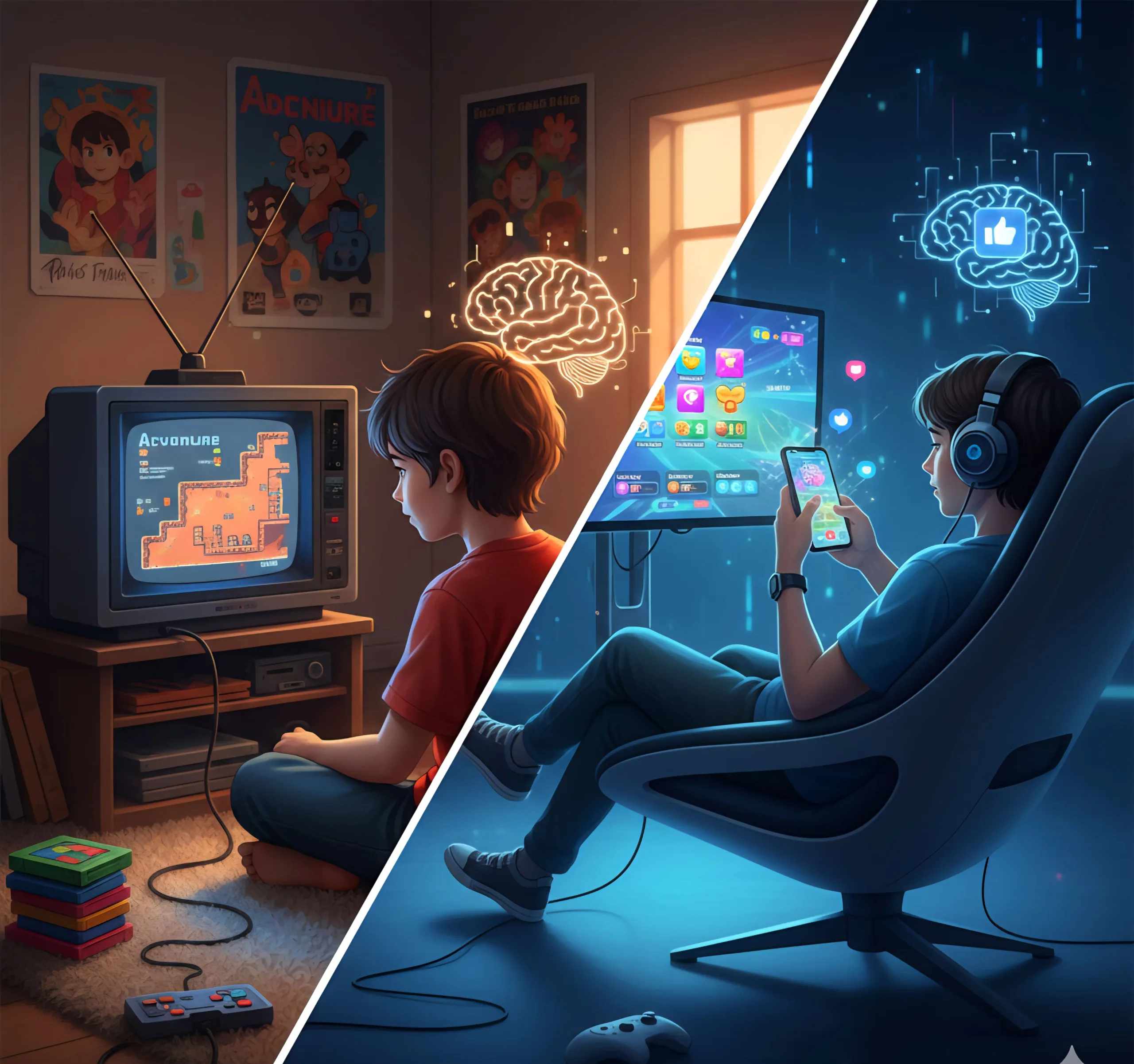
90s kids vs. Gen Z: A psychological look at how retro gaming hardwired a generation for resilience, creativity, and focus compared to the dopamine-driven design of modern tech.
Bio:
The Rewired Brain: Why 90s Kids Think Differently 🧠🎮
It’s not just nostalgia—it’s neuroscience. A psychologist reveals how the limitations of 90s technology actually built superior brain architecture. Here is the breakdown:
1. The Failure Loop 🔄
* 90s Games: 3 lives. No hints. No shortcuts. You failed, you adapted, you persevered.
* Today: Instant respawns and endless guidance. When the struggle vanishes, so does resilience.
2. Cognitive Mapping 🗺️
* The Classics: Games like Zelda and Doom forced you to memorize paths and recognize patterns.
* Today: On-screen arrows dictate every move. 90s brains stored info; modern brains outsource it.
3. Fast vs. Slow Dopamine ⏳
* 90s Rewards: Progress took weeks. Slow dopamine built discipline.
* Today: Loot boxes and upgrades every minute. High-speed dopamine destroys patience.
4. The End of the Loop 🛑
* Retro: Games had an end. You finished or you stopped.
* Modern: “Live service” games never end. They aren’t designed for play; they’re designed to keep you from leaving.
5. Boredom = Creativity 💡
* Then: Boredom sparked imagination.
* Now: Infinite stimulation means the brain never learns how to create from nothing.
6. Real Social Connection 🛋️
* Then: Same couch, shared controllers, shared victories.
* Now: Thousands of “friends” online, yet more isolated than ever.
7. Focus as a Superpower ⚡
* Then: Beating a level took hours of deep focus.
* Now: Attention is hijacked every 15 seconds. Deep focus used to be normal; now, it’s a competitive advantage.
The Bottom Line:
90s tech built Thinkers. Modern tech builds Consumers.
If you don’t control the screen, the screen controls you.

 Home
Home Reviews
 Games tips
 News
News More
More Best Deals
 Privacy Policy
Comments